Learning Outcomes:
i. Comprehend the various methods for synthesizing amines, including alkylation of ammonia, reduction of nitriles, nitro compounds, and amides.
ii. Understand the mechanisms involved in the preparation of amines from different precursors.
iii. Identify the reagents and conditions required for each synthetic method and the factors that influence the reactivity of precursors.
iv. Appreciate the versatility of amines and their importance as intermediates in organic synthesis.
Introduction:
Amines are ubiquitous in nature and play crucial roles in various biological processes. They are also essential in organic synthesis, serving as intermediates in the production of pharmaceuticals, dyes, and other valuable compounds. Understanding the preparation of amines is essential for organic chemists to access this diverse and important class of compounds.
i. Alkylation of Ammonia:
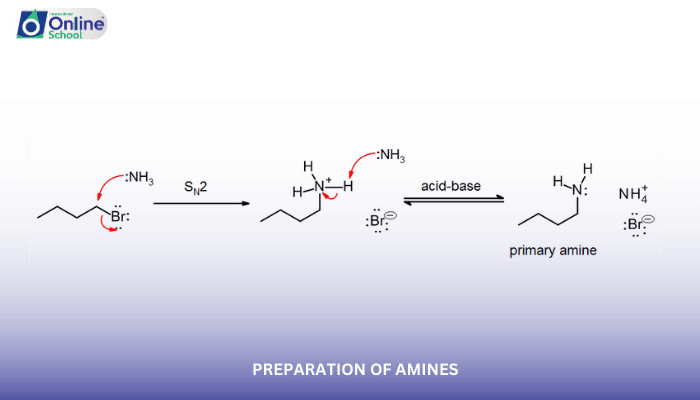
Alkylation of ammonia involves the reaction of ammonia (NH3) with alkyl halides (RX) to form alkyl amines. The reaction proceeds through a nucleophilic substitution mechanism, where the nitrogen atom in ammonia acts as a nucleophile, attacking the electrophilic carbon atom in the alkyl halide.
Primary Amines: Primary amines (RNH2) are obtained by reacting ammonia with primary alkyl halides (R1X).
Secondary Amines: Secondary amines (R2NH) are formed by reacting primary amines with primary or secondary alkyl halides.
Tertiary Amines: Tertiary amines (R3N) can be synthesized by reacting secondary amines with secondary or tertiary alkyl halides.
ii. Reduction of Nitriles:
Nitriles (R-C≡N) can be reduced to primary amines using various reducing agents, such as hydrogen in the presence of a metal catalyst or lithium aluminum hydride (LiAlH4).
Hydrogenation: Nitriles are hydrogenated to primary amines using hydrogen gas (H2) in the presence of a metal catalyst, such as nickel (Ni) or platinum (Pt).
LiAlH4 Reduction: Nitriles are reduced to primary amines using lithium aluminum hydride (LiAlH4) in an inert solvent, such as ether or tetrahydrofuran (THF).
iii. Reduction of Nitro Compounds:
Nitro compounds (R-NO2) can be reduced to primary, secondary, or tertiary amines depending on the reducing agent and reaction conditions.
Iron-Catalyzed Reduction: Nitro compounds are reduced to primary amines using iron (Fe) in the presence of an acid, such as acetic acid (CH3COOH).
Tin-Catalyzed Reduction: Nitro compounds are reduced to secondary amines using tin (Sn) in the presence of hydrochloric acid (HCl).
Zinc-Catalyzed Reduction: Nitro compounds are reduced to tertiary amines using zinc (Zn) in the presence of an ammonium salt, such as ammonium chloride (NH4Cl).
iv. Reduction of Amides:
Amides (RCONH2) can be reduced to primary amines using lithium aluminum hydride (LiAlH4) in an inert solvent, such as ether or tetrahydrofuran (THF). The preparation of amines involves various synthetic methods, each with its own advantages and limitations. The choice of method depends on the desired amine product, the availability of precursors, and the desired reaction conditions. Understanding the mechanisms and factors influencing reactivity is essential for selecting the appropriate synthetic pathway and optimizing reaction outcomes. Amines are valuable intermediates in organic synthesis, leading to the production of a wide range of pharmaceuticals, dyes, and other important compounds.
